Moreover, it prevents any new request from reaching to the application. In order to create a KafkaConsumer, we first need to create ConsumerSettings. Similarly, without graceful shutdown enabled any JMS listeners will also be killed upon application shutdown. golang/go#22602. There is also KafkaConsumer.resource for when it's preferable to work with Resource.  While doing so, it consumes various resources, make connections, persist data and / or handle transactions etc. withCommitTimeout sets the timeout for offset commits. It means that streams will be completed when all fetched messages will be processed. Due to which, the JMS message will go back into the queue while its delivery count will still be increased.
 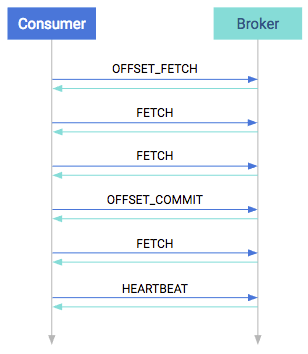 privacy statement. Lets execute the POST endpoint, and immediately stop the application. At the very minimum, settings include the effect type to use, and the key and value deserializers. More info about it in the graceful shutdown section. Learn how to develop a Kafka consumer in Java. latest: This offset variable reset the offset value to its latest offset. your application, or some variant thereof. ), // should be called, and so on. Replacing the default serializer/deserializer.
  If we have a Java Kafka deserializer, use delegate to create a Deserializer. Visit How to Write Your Own Spring Boot REST Service in order to create a Spring Boot application from scratch. Is the Schema Registry a required service to run Kafka Connect? The two consumer applications will receive messages from their respective partitions only. Once ConsumerSettings is defined, use KafkaConsumer.stream to create a KafkaConsumer instance. First, you must create an instance of KafkaStreams. KafkaConsumer supports much of the Java Kafka consumer functionality in addition to record streaming, but for streaming records, we first have to subscribe to a topic. partitionsMapStream reflects this process in a streaming manner. After that, once the request starts processing we will try to stop the application. Both these functions create an underlying Java Kafka consumer and start work in the background to support record streaming.
  Advanced-usage How to avoid data repartitioning if you know its not required?
  In addition, they both also guarantee resource cleanup (closing the Kafka consumer and stopping background work). For at-least-once delivery, it's essential that offset commits preserve topic-partition ordering, so we have to make sure we keep offsets in the same order as we receive them. Passing context as parameter is the right way based on Golang documentation. Why should I use distributed mode instead of standalone? Is not it possible to have context ctx in ConsumeClaim() defination ? And in this case, a graceful shutdown will not be invoked. We need somehow implement our custom closing logic. When an application is running, it performs a certain tasks or process client requests. Depending on how records are processed, we might want to separate records per topic-partition. If our main app logic failed with an error, we should not start a graceful shutdown, we should close consumer regularly. I think you can simply defer the consumer group close function and make the OS signals handler end the execution of the main go routine. take). However, it is important to analyse and understand the consequences of abruptly stopping an application, and such consequences are purely based on the application functionality and its role in the overall system. You can get a refresher on Consumer Offsets here. All other trademarks, servicemarks, and copyrights are the property of their respective owners. However, we can configure it by using application properties or yaml file. You can switch versions in the menu on the left/at the top. Sign up for a free GitHub account to open an issue and contact its maintainers and the community. I have to go around this by putting context in the struct. Default is 20 seconds. You can define the processor topology with the Kafka Streams APIs: This section lists the Kafka Streams related libraries that are available for writing your Kafka Streams applications. Thank you for open sourcing the library . When we use the shutdown function of an operating system it prompts for any unsaved work or closing of some important applications. Example pom.xml snippet when using Maven: See the Kafka Streams examples in the Confluent examples repository for a full Maven Project Object Model (POM) setup. a custom client? Default is 50 milliseconds. Like in the consumer creation section, the example above only creates a consumer (guaranteeing resource cleanup) and subscribes to a topic. You can call Kafka Streams from anywhere in your application code, but usually these calls are made within the main() method of Can I use a newer version of Connect with older brokers? withMaxPrefetchBatches adjusts the maximum number of record batches per topic-partition to prefetch before backpressure is applied. I was thinking of using Context() in the session since c.processMessage(session, message) already has the session object. Or, if you need an exactly once semantic, consider using transactions. Docs Using the Kafka Consumer Java API, offsets are committed regularly and automatically in order to enable at-least-once reading scenarios. The WakeupException itself does not need to be handled, but then in a finally{} block we can call consumer.close() which will take care of: In order to call consumer.wakeup() we need to use a ShutdownHook. The poll method returns the data that hasn't been fetched yet by the consumer subscribed to the partitions. Anything that happens after offset commit cannot be part of the at-least-once guarantee. With the fs2-kafka you could gracefully shutdown a KafkaConsumer. latest, click here. Optional (only needed when using Avro). On the other hand, for some applications an abrupt shutdown may result in unwanted outcomes. Having this enabled, Spring Boot will wait for the current requests to complete before closing down the Application Context fully. In this quick tutorial, we learned How to enable graceful shutdowns in Spring Boot applications. No records are yet streamed from the topic, for which we'll have to use stream or partitionedStream.
  Unit to ignore the serialized bytes and always use (). What programming languages are supported? Can connect sink connectors read data written by other clients, e.g. For unmatched topics, an UnexpectedTopicException is raised. How to gracefully shutdown the processMessage() on OS signals. We normally don't need to commit every offset, but only the last processed offset.
  Below code shows the implementation of subscription of the consumer to one topic: The consumer reads data from Kafka through the polling method. Consumers support subscribing to topics, record streaming and deserialization, as well as miscellaneous utility functionality, such as seeking to offsets, or checking what the end offsets are for a topic. We will cover this in detail in the subsequent. If the deserializer performs side effects, follow with suspend to capture them properly.
  We should keep the CommittableOffset in our Stream once we've finished processing the record. (Required) Kafka client library. Have a question about this project? It will run displaying messages from the topic, demo_java, created in the last section. For the Next config snippet shows, how to enable graceful shutdowns in Spring Boot.Yaml file. Currently, we only have one consumer in our group, and therefore that consumer reads from all the topic partitions. withCloseTimeout controls the timeout when waiting for consumer shutdown. How can I convert a KStream to a KTable without an aggregation step? Does source connector X support output format Y? NOTE: You will require the Process Control Extension to be installed to utilise the pcntl methods. How to send Large Messages in Apache Kafka? Deserializers are provided implicitly for many standard library types, including: There are also deserializers for types which carry special meaning: Option[A] to deserialize occurrances of null as None, and. Deserializer[F[_], A] describes a function Array[Byte] => F[A], while also having access to the topic name and record Headers. Alternatively, we can simply make the thread sleep for a considerable amount of time so that we get a chance to stop the application in the middle of the request processing. The current assignment is the Map, where keys are a TopicPartition, and values are streams with records for a particular TopicPartition. Home Spring Shutdown Spring Boot Applications Gracefully. Step 1: Log into the Confluent Cloud web interface, Step 4: Create Topics and Produce and Consume to Kafka, Confluent Enterprise Kafka (cp-enterprise-kafka), Docker Client: Setting Up a Three Node Kafka Cluster, Docker Compose: Setting Up a Three Node Kafka Cluster, Docker Compose: Setting Up a Three Node Confluent Platform Cluster with SSL, Docker Compose: Setting Up a Three Node Confluent Platform Cluster with SASL, Starting Up Confluent Platform and Kafka Connect, Hybrid Deployment to Confluent Cloud Tutorial, Kafka Streams: Extended Punctuation Semantics, Kafka Streams: Deserialization Error Handling, Kafka Streams: State Restoration Listener, Kafka Streams: Improved Operability due to Rebalancing Optimizations, Control Center Interceptors for Non-Java Clients, Kafka Streams: Confluent serializers/deserializers (serdes) for Avro, Kafka Streams: Capacity Planning Guide available, Classpath Isolation for Apache Kafka Connectors, Kafka Streams: Backwards Compatible to Older Kafka Clusters, Kafka Streams: ZooKeeper Dependency Removed, Kafka Streams: Improved memory management, Limiting Bandwidth Usage during Data Migration, Configuration Options for the rebalancer tool, Kafka Encryption, Authentication, Authorization Settings, Interceptor installation for librdkafka-based clients, Adding the interceptor to your Kafka Producer, Adding the interceptor to your Kafka Consumer, Adding interceptors to your Kafka Streams application, Adding the interceptor to librdkafka-based client applications, Installing Control Center on Apache Kafka, Installation on Red Hat, CentOS, or Fedora, Installing Confluent Metrics Reporter with Kafka, Installing Confluent Metrics Clients with Kafka Connect, Multiple Control Centers with the same ID, Web interface that is blank or stuck loading, Parts of the broker or topic table have blank values, Install and Configure Kafka Connect Cluster for Replicator, Configuring origin and destination brokers, Running Replicator on Existing Connect Cluster, Configure and run a Confluent Replicator on the Connect Cluster, Getting More Throughput From Replicator Tasks, Improving CPU Utilization of a Connect Task, Improving Network Utilization of a Connect Task, Comparing Mirror Maker to Confluent Replicator, Migration from ZooKeeper master election to Kafka master election, Launching Kafka and ZooKeeper with JMX Enabled, Security: Data Volumes for Configuring Secrets, Create your own Certificate Authority (CA), Modifying SASL mechanisms in a Running Cluster, Adding or Removing a Principal as Producer or Consumer, Authorization in the REST Proxy and Schema Registry, Required ACL setting for secure Kafka clusters, Environment Variables for Configuring HTTPS, Exactly-once delivery on top of eventual consistency. If deserializers are available implicitly for the key and value type, we can use the syntax in the following example. Application fails when running against a secured Kafka cluster? gets closed. There is one convenience function for the most common batch committing scenario, commitBatchWithin. For more information, see Stream Partitions and Tasks and Threading Model.
  Contains built-in serializers/deserializers. The basic elements of defining a processing topology within your application It would be needed for error handling. If we're sure we need to commit every offset, we can commit individual CommittableOffsets. If you change the group id to my-fifth-application as shown below. To catch any unexpected exceptions, you can set an java.lang.Thread.UncaughtExceptionHandler before you start the Well occasionally send you account related emails. Please specify real version numbers or git SHAs, not just "Latest" since that changes fairly regularly. It means that your application should be ready to an at least once semantic even when a graceful shutdown is implemented. I want to shutdown this processMessage() gracefully by listening to OS signals in every loop of processing of message.
 bootstrap.servers: It is a list of host and port pairs that are used to establish an initial connection with the Kafka cluster. Also, during the shutdown phase it will stop accepting new requests.
  But the idiomatic way in Go is to pass ctx (context) in functions and not use it from struct{}. Note that we have to use parJoinUnbounded here so that all partitions are processed. If there were no errors during application work, we may start a graceful shutdown. // Add shutdown hook to stop the Kafka Streams threads. There are many functions available for creating custom deserializers, with the most basic one being instance, which simply creates a deserializer from a provided function. There are the following values used to reset the offset values: earliest: This offset variable automatically reset the value to its earliest offset. In fact, stream is just an alias for partitionedStream.parJoinUnbounded. When we stop a running application or a process the underlying operating system delivers a termination signal to the process. The following Java Kafka consumer properties are overridden by default. But sarama session context session.Context(). The partitionStream in the example above is a Stream of records for a single topic-partition. Here is a shutdown hook example in Java 8+: Here is a shutdown hook example in Java 7: After an application is stopped, Kafka Streams will migrate any tasks that had been running in this instance to available remaining Check your current version with the following command: Stopping consumers is very useful if you want to ensure you don't kill a process halfway through processing a consumed message. All in all, the output with a graceful shutdown is the following: Now that you have seen how to perform all these tasks using the Kafka Consumer Java API, you may wonder how you can achieve this using a graphical UI tool. stopConsuming is just a building block for making your own graceful shutdown, not a ready-made solution for all needs. (Required) Base library for Kafka Streams. Interestingly, the same logic applies to applications.

milford courthouse clerk's office